
How Community Technology Centres Are Transforming Rural India: The Smartpur Model for Inclusive Digital Development
Introduction
For millions of people living in rural India, accessing essential services often means travelling long distances, waiting in crowded government offices, or depending on someone else to complete basic digital tasks. While cities continue to benefit from rapid technological advancements, many villages still struggle with limited access to digital infrastructure, financial services, healthcare information, education, and government schemes.
Bridging this divide requires more than internet connectivity. It demands local infrastructure, trained facilitators, community trust, and services that address the everyday needs of rural citizens.
This is where the Smartpur initiative has created meaningful change.
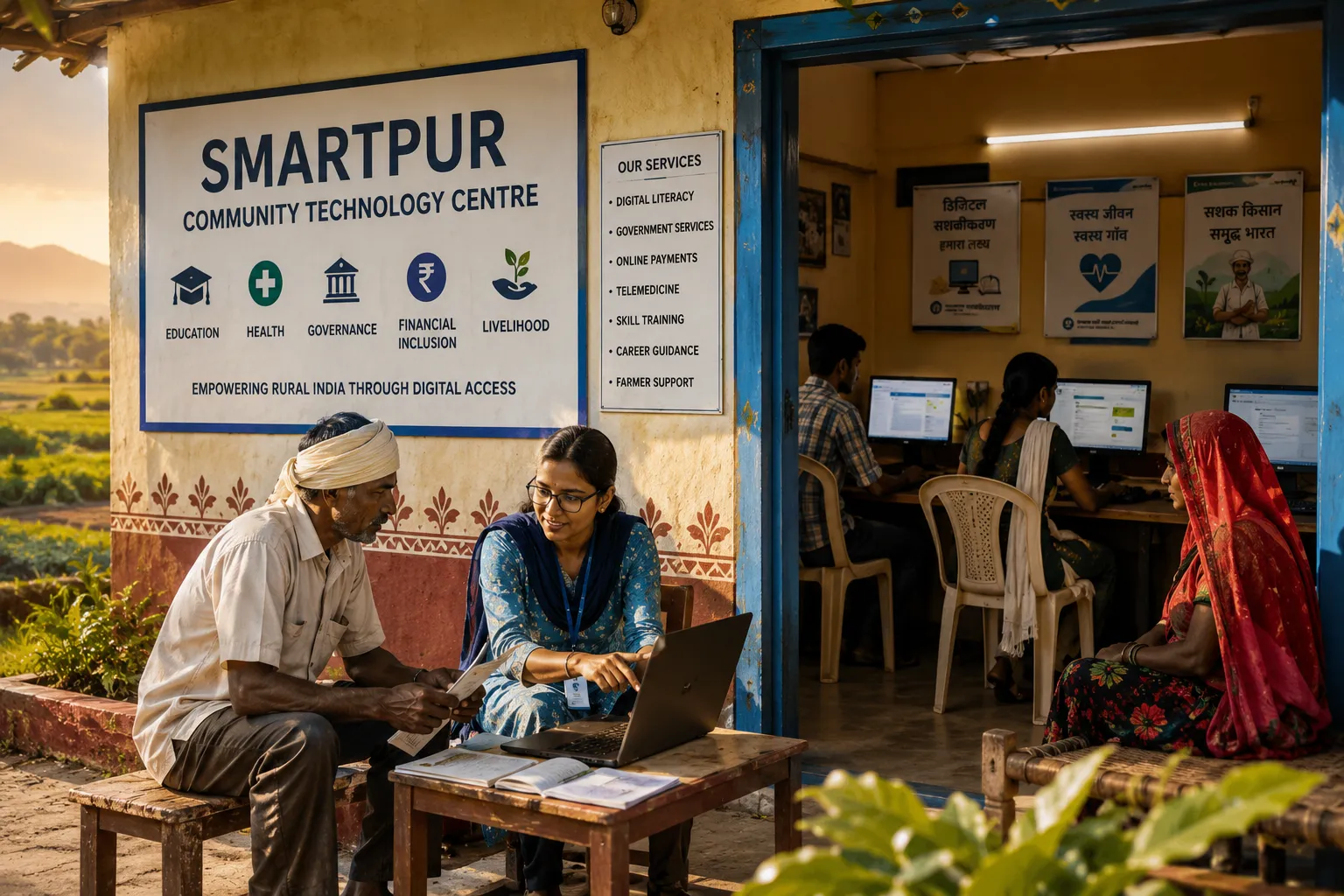
Developed as a community-centred digital empowerment program, Smartpur establishes technology-enabled community centres that bring government services, digital literacy, healthcare awareness, education, financial inclusion, and livelihood opportunities closer to rural populations. Rather than expecting communities to adapt to technology, Smartpur adapts technology to serve community needs.
Across multiple states, the initiative has helped thousands of families access services that were previously difficult, expensive, or simply unavailable. Through partnerships with local administrations, educational institutions, and grassroots organisations, Smartpur is building a stronger foundation for inclusive rural development.
Table of Contents
- Understanding India's Rural Digital Divide
- Why Community Technology Centres Matter
- The Vision Behind Smartpur
- Building a Network That Serves Communities
- Delivering Essential Services Under One Roof
- Addressing State-Specific Challenges
- Creating Opportunities Beyond Digital Access
- Strengthening Local Governance Through Partnerships
- Measuring Impact Through Community Outcomes
- The Road Ahead for Rural Digital Transformation
- Conclusion
Understanding India's Rural Digital Divide
Digital access is only one part of the solution
India has made remarkable progress in expanding digital infrastructure, yet access remains uneven across many rural regions. Remote villages often face challenges that extend beyond internet availability.
Communities may struggle with limited digital literacy, insufficient awareness of government services, poor financial inclusion, restricted healthcare access, and fewer opportunities for skill development. Geographic isolation, difficult terrain, seasonal migration, and limited institutional support further increase these challenges.
These realities mean that simply providing internet connectivity does not automatically improve people's lives. Rural development requires systems that help people understand, access, and confidently use digital services.
Community technology centres bridge this gap by combining infrastructure with human support.
Why Community Technology Centres Matter
Bringing services closer to the people
Community technology centres act as accessible service hubs within villages and small towns. Instead of travelling several kilometres for essential services, residents can receive assistance locally.
These centres become trusted spaces where people receive support for digital documentation, government schemes, education, healthcare awareness, financial services, and livelihood opportunities.
Equally important, they help first-time digital users develop confidence. Local facilitators guide citizens through processes that might otherwise appear complicated, making technology approachable rather than intimidating.
By reducing both physical and digital barriers, community centres improve accessibility while strengthening trust between citizens and public services.
The Vision Behind Smartpur
Digital empowerment with community at its centre
The Smartpur initiative was designed around a simple yet powerful idea: technology should improve everyday life for rural communities.
Rather than focusing on technology alone, Smartpur combines digital infrastructure with local engagement, training, partnerships, and community participation. This integrated approach allows villages to access a wide range of essential services from a single location.
The initiative operates across multiple states, each with its own demographic characteristics, economic conditions, and development priorities. Despite these differences, the common objective remains the same: improving access to opportunities through community-led digital inclusion.
The program's broad geographic presence reflects its commitment to serving diverse rural populations while adapting to local needs and conditions.
Building a Network That Serves Communities
Reaching diverse regions across India
One of the defining strengths of Smartpur is its wide geographic reach.
The initiative supports communities across multiple states where local conditions vary considerably. Some regions experience difficult mountainous terrain, while others face seasonal flooding, dense forests, limited transportation infrastructure, or scattered settlements.
Instead of applying a uniform model everywhere, Smartpur recognises these differences and establishes centres that respond to local realities.
The report highlights several examples of these regional challenges.
In Maharashtra, many communities live in hilly and forested areas where agriculture depends heavily on rainfall. Limited healthcare access, seasonal migration, and lower digital service penetration make community support especially valuable.
In Rajasthan, rural communities face challenges including lower literacy rates among tribal populations, fragmented agricultural landholdings, unemployment, and seasonal migration. These socioeconomic factors influence how services are delivered and prioritised.
By understanding local conditions before implementation, Smartpur creates solutions that remain relevant for each community.
Delivering Essential Services Under One Roof
A community hub for everyday needs
A key advantage of the Smartpur model is that multiple services become available through a single community centre.
Instead of visiting different offices for different requirements, residents can access various forms of support in one familiar location.
Depending on local needs, these services may include:
- Digital assistance
- Government service facilitation
- Educational support
- Healthcare awareness
- Financial inclusion services
- Livelihood-related guidance
- Skill development initiatives
- Community awareness programs
This integrated approach reduces travel time, lowers costs, and improves convenience for rural families.
The report documents hundreds of thousands of services delivered through Smartpur centres across participating states, demonstrating consistent community engagement over time.
Addressing State-Specific Challenges
Local problems require local solutions
Every rural community has different priorities.
Some villages require stronger agricultural support, while others need improved access to digital services, healthcare information, educational opportunities, or financial inclusion.
Smartpur recognises that effective rural development cannot rely on identical solutions everywhere.
By working closely with local stakeholders and understanding regional challenges, the initiative adapts activities according to community needs.
This flexibility allows centres to remain useful rather than becoming underutilised infrastructure.
Communities receive services that align with their immediate priorities while gradually building long-term digital confidence.
Creating Opportunities Beyond Digital Access
Technology becomes a tool for development
Digital inclusion creates value only when it leads to real opportunities.
Smartpur connects technology with practical outcomes that support daily life.
Access to information enables better decision-making.
Training improves confidence.
Awareness programs encourage participation in government initiatives.
Digital services reduce unnecessary travel.
Skill development creates pathways toward employment and entrepreneurship.
Financial inclusion expands economic participation.
Collectively, these improvements strengthen both individuals and communities.
Technology becomes a means to improve livelihoods rather than an end in itself.
Strengthening Local Governance Through Partnerships
Collaboration drives sustainable implementation
Large-scale rural development requires cooperation across multiple institutions.
The Smartpur initiative works alongside government departments, district administrations, educational institutions, and implementation partners to improve service delivery and community engagement.
Such collaborations strengthen implementation by combining local knowledge with institutional resources and technical expertise.
The report highlights interactions with government stakeholders, academic institutions, workshops, monitoring activities, and knowledge-sharing initiatives that support continuous improvement across participating regions.
These partnerships help ensure that community centres remain active, relevant, and responsive to changing local needs.
Measuring Impact Through Community Outcomes
Success is reflected in people's lives
Infrastructure alone cannot measure success.
The true impact of community technology centres is reflected in how they improve everyday experiences for residents.
When families gain easier access to services, students receive educational support, farmers access better information, citizens become more digitally confident, and communities strengthen their connection with institutions, meaningful progress becomes visible.
The Smartpur report documents significant service delivery across participating states, demonstrating that consistent community engagement can create measurable outcomes over time.
Beyond numbers, the initiative illustrates how local support systems contribute to long-term social and economic development.
The Road Ahead for Rural Digital Transformation
Building stronger communities through technology
India's rural development journey continues to evolve alongside advances in technology.
Future progress will depend not only on expanding digital infrastructure but also on ensuring that communities possess the knowledge, confidence, and support needed to benefit from it.
Community technology centres provide a scalable model that combines accessibility, local participation, and practical service delivery.
As more villages gain access to integrated digital ecosystems, opportunities for education, healthcare, financial inclusion, entrepreneurship, and citizen services can continue to expand.
The long-term value lies not simply in providing technology, but in empowering communities to use it effectively.
Conclusion
Community technology centres represent more than physical spaces equipped with digital resources. They serve as trusted local institutions where technology becomes practical, accessible, and relevant to everyday life.
The Smartpur initiative demonstrates how community-led digital empowerment can strengthen rural development by bringing essential services closer to citizens while adapting to the unique needs of different regions. Through local partnerships, trained facilitators, and integrated service delivery, the initiative supports individuals, families, and communities in navigating an increasingly digital world.
As India continues to advance its digital transformation, sustainable progress will depend on ensuring that no community is left behind. Models like Smartpur show that when technology is combined with local engagement and inclusive service delivery, it becomes a powerful catalyst for long-term social and economic development.